
Food Plastic Storage Box Inspection – Quality Assurance for Containers Used for Food Contact, Freezing, Microwave Heating and Dishwasher Cleaning
As an ISO/IEC 17025 accredited (CNAS) independent laboratory, we provide specialized inspection and testing services for food plastic storage boxes to manufacturers, retailers, importers and quality control laboratories in Austria. Plastic food storage boxes (made from polypropylene – PP, polyethylene – PE, polycarbonate – PC, Tritan, SAN, and other food‑contact approved plastics) are widely used in households, catering, meal prep services and industrial food storage. They must comply with strict food contact regulations (EU Regulation 10/2011, LFGB, and Austrian food safety standards) to ensure that no harmful substances migrate into food. Additionally, they must withstand repeated use: mechanical strength against impact and stacking, dimensional stability under freezing temperatures, heat resistance for microwave use, and durability through dishwashing cycles. Our laboratory performs migration testing (overall migration, specific migration of additives), mechanical testing (drop test, compression test, lid seal strength), thermal testing (low‑temperature impact, heat resistance), and optical inspection (color, transparency, defects). Results help manufacturers verify compliance, ensure safe food contact, and certify product durability for household and commercial applications.
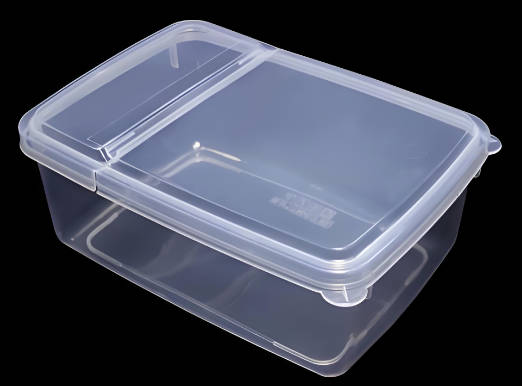
Types of Food Plastic Storage Box Samples We Test
- Lidded containers for refrigerated and frozen food storage (PP, PE, PET)
- Microwave‑safe containers with venting lids (PP, high‑temperature copolyester)
- Dishwasher‑safe boxes (stain‑resistant and warp‑resistant grades)
- Stackable modular containers for pantry organization
- Meal prep boxes with multiple compartments
- Disposable and reusable lunch boxes (for school, office, travel)
- Vacuum storage containers (with air‑tight seal testing)
- Baby food storage boxes (sterilizable and BPA‑free certified)
- Factory production samples (for batch release and incoming inspection)
- Competitor products (benchmarking of mechanical durability and seal integrity)
Key Quality Parameters and Defects Detected
- Food contact safety (migration of harmful substances) – Overall migration into food simulants (water, ethanol, acetic acid, olive oil) and specific migration of additives (bisphenol A, phthalates, primary aromatic amines, heavy metals).
- Dimensional accuracy and stability – Lid fit, container squareness, rim flatness; warpage or distortion after molding, freezing or microwave heating.
- Mechanical strength – Resistance to impact (drop test from 1 meter), compression strength (stacking load), lid snap‑lock retention after repeated opening/closing.
- Seal integrity (liquid‑tight closure) – Ability to prevent leakage of liquids when inverted or shaken; measured by water fill and pressure test.
- Thermal resistance – No deformation, cracking, or softening at specified temperatures: freezer (–20°C), microwave heating (100°C steam), boiling water (100°C) and dishwasher (65°C with detergent).
- Optical defects (color, clarity, surface finish) – Discoloration, haze, black specks, flow marks, sink marks, excessive flash at sealing rim, scratches, and poor transparency.
- Hygiene and cleanability – Absence of crevices, sharp corners, or surface roughness that could trap food residues and bacteria.
Test Methods – Detailed Description
1. Food Contact Migration Testing (EU 10/2011)
We perform overall migration tests using food simulants (10% ethanol, 3% acetic acid, 20% ethanol, 50% ethanol, and rectified olive oil) at temperatures and durations simulating worst‑case food contact (e.g., 100°C for 2 hours for hot‑fill, 40°C for 10 days for long‑term storage). After exposure, the simulant is evaporated, and the residue is weighed. The overall migration limit is ≤ 10 mg/dm² of contact surface. For specific migration, we analyze leachates for bisphenol A (BPA, limit 0.05 mg/kg), phthalates (regulated by EU), lead, cadmium, and primary aromatic amines (not detectable).
2. Drop Test (Mechanical Impact Resistance)
A filled container (with water or simulated food mass) is dropped from a height of 1 meter onto a concrete or steel surface in a controlled orientation (base down, edge, corner, lid side). After three drops, the box is inspected for cracks, fractures, lid detachment, or permanent deformation. Acceptance: no leakage or structural failure.
3. Compression Strength (Stacking Load Test)
An empty container with lid is placed between two compression plates. A force is applied at a constant speed (10 mm/min) until the container collapses or until a target load (e.g., 200 N for a 1‑liter box) is reached. The maximum load and deformation are recorded. This simulates stacking during storage and transport.
4. Lid Seal Leakage Test (Liquid‑Tightness)
The container is filled with water (or colored water for easier detection), the lid is securely closed, and the container is inverted over absorbent paper for 30 seconds. Any liquid seepage indicates a seal defect. For pressure‑tight containers (vacuum boxes), we apply a slight positive pressure (0.2 bar) while submerged and look for air bubbles.
5. Thermal Resistance
Low‑temperature test: The empty container is placed in a freezer at –20°C for 24 hours. It is then visually inspected for cracks, crazing, or brittleness. A drop test at the same temperature may also be performed (using a cold‑conditioned sample).
Microwave heating test: The container is filled with water or a 3% NaCl solution (to simulate food), covered with its lid (with vent open if required), and heated in a microwave oven at full power (900 W) for 5 minutes. After heating, we check for warping, melting, lid deformation, and whether the container can be handled without burning (surface temperature measured).
Boiling water test: The container is immersed in boiling water for 10 minutes, then immediately placed in cold water (thermal shock). No cracking or crazing allowed.
Dishwasher test: The container is placed in a dishwasher and run through a full cycle (65°C, with standard detergent) for 50 cycles (accelerated durability). After each 10 cycles, we check for loss of gloss, staining, warpage, or lid seal weakening.
6. Dimensional Stability and Warpage Measurement
Using a digital caliper and a surface plate, we measure the lid‑to‑container fit (gap), the straightness of rims, and the squareness of corners before and after thermal conditioning. A warpage exceeding 2 mm over 100 mm length is considered a defect.
7. Visual and Optical Inspection
Under standardized lighting (D65 illuminant, 1000 lux), trained inspectors evaluate the container for color uniformity, transparency (haze), surface defects (scratch, sink mark, flow line, flash, black specks). For transparent containers, we use a haze meter to quantify light transmission and haze percentage (ASTM D1003). Acceptable haze for clear containers is usually ≤ 5%.
8. Lid Opening/Closing Cycle Test (Endurance)
A mechanical fixture repeatedly opens and closes the lid (or snaps the latch) for 1000 cycles. After the test, we check for cracks at the hinge, loss of snap‑fit retention, and whether the seal still passes the leakage test.
Quality Control and Acceptance Criteria (Typical Benchmarks)
The following are typical requirements for high‑quality food storage boxes intended for household use. Clients must provide their specific specifications.
- Overall migration (food simulants): ≤ 10 mg/dm²
- BPA specific migration: not detectable (< 0.01 mg/kg)
- Drop test (1 m, three drops): no cracks, no leakage
- Compression strength (1L box): ≥ 200 N without collapse
- Leakage test (inverted 30 seconds): zero water seepage
- Microwave test (5 min, 900 W): no deformation, surface temperature ≤ 70°C
- Dishwasher test (50 cycles): no warpage, no loss of seal integrity
- Haze (clear containers): ≤ 5%
- Lid cycle test (1000 cycles): seal still passes leakage test, hinge intact
Reporting and Deliverables
Each food plastic storage box inspection report includes the following information:
- Sample identification (material type, color, nominal capacity, manufacturer, batch number, intended use conditions – freezer/microwave/dishwasher)
- Food contact migration results (overall and specific migration with test conditions)
- Mechanical performance (drop test result, compression load‑deformation curve, lid seal leakage test result)
- Thermal performance (low‑temperature test, microwave test, dishwasher test observations)
- Dimensional measurements (warpage, lid fit)
- Optical inspection (haze %, defects list, photographs)
- Lid endurance test result (cycles performed, final seal integrity)
- Comparison with client‑supplied specifications (if provided) – pass/fail conclusion
- Raw data (migration residues, thermal images, test curves) archived for 10 years
No statement of compliance with any external standard or regulation is made unless the client has provided specific acceptance criteria in writing. The report is intended for product certification, production quality control, and supplier verification.
Applications in the Austrian Food Packaging and Household Goods Industry
- Plastic container manufacturers (Tyrol, Upper Austria, Styria): Routine batch release testing for food contact compliance and mechanical durability.
- Retailers and discount chains (e.g., BILLA, Spar, Hofer, Lidl Austria): Supplier verification and product benchmarking before market launch.
- Meal prep services and catering companies: Qualification of reusable containers for freeze‑and‑heat meals.
- Importers and distributors (especially for non‑EU manufactured goods): Verification of EU food contact compliance.
- Consumer safety testing: Post‑market surveillance of storage boxes for compliance with LFGB and Austrian food safety regulations.
Why Choose ZKGX?
- State-of-the-art analytical equipment
- Highly qualified scientific team
- Fast turnaround time
- Competitive pricing