
Copper‑Clad Aluminum Inspection – Quality Assessment of Bimetallic Conductors for Electrical and Communication Cables
As an ISO/IEC 17025 accredited (CNAS) independent laboratory, we provide specialized inspection and testing services for copper‑clad aluminum (CCA) conductors to cable manufacturers, power distribution companies, telecommunications providers, and quality assurance laboratories in Austria. Copper‑clad aluminum wire consists of an aluminum core with a metallurgically bonded copper outer layer. It combines the weight savings and cost benefits of aluminum with the excellent corrosion resistance, solderability, and surface conductivity of copper. CCA is widely used in coaxial cables, control cables, building wire, power cables (where weight reduction is critical), and high‑frequency signal transmission (skin effect applications). The quality of the bimetallic bond, copper layer thickness uniformity, electrical conductivity, tensile strength, ductility, and surface condition determine the conductor's performance and service life. Our laboratory performs destructive and non‑destructive tests: copper layer thickness measurement (microscopy, eddy current, X‑ray fluorescence), bond integrity (twist test, adhesion peel test), electrical conductivity (IACS%), mechanical properties (tensile, elongation, bend), and corrosion resistance (salt spray, galvanic potential). We follow international standards (ASTM B566, IEC 60468, EN 13602, ÖNORM E 6240) and adapt to Austrian electrical installation requirements. Results help manufacturers control cladding process parameters, verify incoming material quality, and certify cables for safety and reliability.
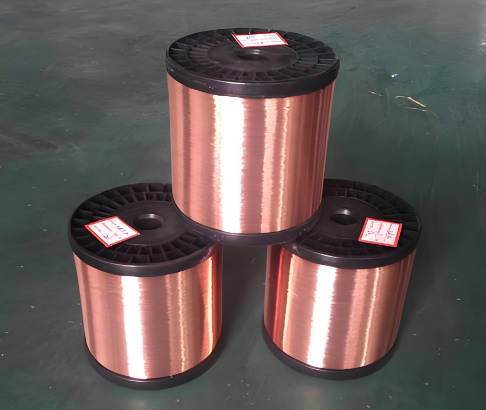
Types of Copper‑Clad Aluminum Samples We Inspect
- CCA wires for coaxial and RF cables (inner conductors)
- CCA solid and stranded conductors for building wiring (e.g., telephone, alarm, instrumentation)
- CCA power conductors (lightweight cables for overhead transmission and automotive harnesses)
- CCA flat wires and busbars for electrical panels
- CCA wires with different volume ratios (10% Cu, 15% Cu, 20% Cu by volume)
- Production samples from drawing and cladding lines
- Failed CCA conductors from field installations (corrosion, breakage, high resistance)
- Reference standards for calibration of thickness measurement instruments
- Competitor benchmark samples
Key Parameters and Defects Detected
- Copper layer thickness and uniformity (nominal thickness, eccentricity) – Insufficient copper thickness reduces corrosion resistance and electrical conductivity; uneven thickness (eccentricity) leads to localized weak points and poor solderability.
- Bond integrity (separation between copper and aluminum) – Poor metallurgical bonding allows moisture ingress, galvanic corrosion, and eventual conductor failure.
- Electrical conductivity (IACS%) – CCA conductivity typically ranges from 40% to 65% IACS, depending on copper volume fraction. Low conductivity increases resistive losses.
- Mechanical properties (tensile strength, elongation, bendability) – Affects handling during installation and fatigue resistance under vibration.
- Surface quality (scratches, pits, oxide spots, copper peeling) – Surface defects compromise solderability and contact resistance.
- Dimensional tolerance (wire diameter, roundness) – Deviation from specification affects connector fit and electrical performance.
- Corrosion resistance (especially in saline or industrial environments) – Poor cladding or exposed aluminum edges lead to galvanic or crevice corrosion.
Test Methods and Inspection Procedures
1. Copper Layer Thickness Measurement
Microscopic cross‑section (reference method) – A wire sample is encapsulated in resin, cross‑sectioned, polished, and etched to reveal the copper‑aluminum interface. Using a calibrated optical microscope (200×–1000×), we measure the copper thickness at multiple points around the circumference. Minimum, average, and eccentricity (max/min ratio) are reported.
Eddy current (non‑destructive) – A handheld eddy current probe measures copper thickness on the wire surface. Calibrated against known standards; suitable for 100% inline inspection.
X‑ray fluorescence (XRF) – Non‑destructive measurement of copper weight percent; from this, the equivalent copper thickness is calculated (given wire diameter and copper density).
2. Bond Integrity Tests
Twist test – A wire specimen is twisted about its axis until failure (typically 10–30 twists). The exposed fracture surface is examined: if the copper layer separates cleanly from the aluminum (without deformation), bond adhesion is insufficient. Acceptable failure shows aluminum necking and copper stretching without separation.
Peel test (for flat CCA strip) – The copper layer is peeled back from the aluminum core at a 90° angle using a universal testing machine. Peel force (N/mm) is recorded; low force indicates weak bond.
Bend test (mandrel bend) – The wire is bent around a mandrel of diameter equal to 3× wire diameter. After bending, the outer copper layer is examined for cracking or separation. No visible separation is allowed.
3. Electrical Conductivity Measurement
A straight, clean wire specimen (length ≥ 300 mm) is placed in a constant‑temperature bath (20°C ± 0.1°C). The electrical resistance is measured using a four‑wire Kelvin bridge (or micro‑ohmmeter). The cross‑sectional area is calculated from mass/length or measured diameter. Conductivity is expressed as % IACS (International Annealed Copper Standard). For CCA, typical values: 10% Cu volume → ~40% IACS; 15% Cu volume → ~48% IACS; 20% Cu volume → ~55% IACS.
4. Mechanical Testing
Tensile test – A wire specimen with gauge length of 200 mm is pulled at a constant speed (10–50 mm/min). Tensile strength (MPa) and elongation at break (%) are recorded. Typical values: tensile strength 120–180 MPa (depending on temper), elongation > 15% (soft annealed).
Bend test (repeated bending) – The wire is bent back and forth over a radius equal to wire diameter until fracture. The number of cycles is recorded (minimum 10 for quality conductors).
5. Surface Quality and Dimensional Inspection
Under a stereomicroscope (10×–50×), the wire surface is examined for longitudinal scratches, pits, copper peeling, oxide spots, and other defects. Outer diameter is measured with a laser micrometer (accuracy ±0.001 mm) at five positions along 1 m length. Roundness is assessed by measuring maximum and minimum diameters at the same cross‑section.
6. Corrosion Resistance (Salt Spray Test)
CCA wire samples are exposed to neutral salt spray (5% NaCl, 35°C) for 48 hours. After exposure, we examine for red rust (copper corrosion), white rust (aluminum corrosion), or blistering of the copper layer. End‑cut edges are particularly vulnerable; we may also apply a protective coating on the cut ends to simulate in‑service conditions.
7. Galvanic Corrosion Potential Measurement
Using a potentiostat, we measure the open‑circuit potential (OCP) of CCA relative to a reference electrode (saturated calomel) in a simulated electrolyte (0.1% NaCl). A large potential difference between copper and aluminum indicates high galvanic corrosion risk if water penetrates the cladding.
Quality Control and Acceptance Criteria (Typical Benchmarks)
The following are typical values for high‑quality CCA wire (15% copper volume, soft annealed). Clients must supply their specific specifications.
- Copper thickness: 15–25 µm (for 0.5 mm diameter wire)
- Eccentricity (max/min copper thickness): ≤ 1.5
- Electrical conductivity: ≥ 48% IACS (for 15% Cu volume)
- Twist test: no copper‑aluminum separation after 15 twists
- Tensile strength: 120–160 MPa (annealed)
- Elongation: ≥ 15%
- Surface defects: no visible peeling, corrosion spots, or deep scratches
- Salt spray (48 hours): no red rust, no blistering
Reporting and Deliverables
Each copper‑clad aluminum inspection report includes the following information:
- Sample identification (wire diameter, copper volume percentage, temper, manufacturer, batch number)
- Copper layer thickness (minimum, maximum, average, eccentricity) and measurement method
- Bond integrity (twist test result, peel force if applicable, bend test observation)
- Electrical conductivity (% IACS) at 20°C
- Mechanical properties (tensile strength, elongation, bend cycles)
- Surface quality (description of defects, diameter tolerance, roundness)
- Corrosion test result (salt spray observations, galvanic potential if measured)
- Comparison with client‑supplied specifications (if provided) – pass/fail conclusion
- Raw data (micrographs, stress‑strain curves, conductivity logs) archived for 10 years
No statement of compliance with any external standard is made unless the client has provided specific acceptance criteria in writing. The report is intended for material certification, production quality control, and procurement verification.
Applications in the Austrian Electrical Industry
- Cable manufacturing (Vienna, Linz, Salzburg): Incoming inspection of CCA wire for coaxial cables, control cables, and lightweight power cables.
- Telecommunications (A1 Telekom, infrastructure providers): Quality verification of CCA used in last‑mile distribution and antenna cables.
- Automotive wiring (suppliers in Steyr, Graz): Lightweight CCA harnesses for electric vehicles – testing for fatigue resistance and corrosion.
- Renewable energy (solar panel interconnects, wind turbine control wiring): Low‑weight CCA for weight‑sensitive applications.
- Import and trade: Compliance verification for CCA conductors imported from non‑EU sources.
Why Choose ZKGX?
- State-of-the-art analytical equipment
- Highly qualified scientific team
- Fast turnaround time
- Competitive pricing