
Airplane Fuel Filter Analysis – Contamination Assessment and Performance Verification for Aviation Fuel Filtration Systems
As an ISO/IEC 17025 accredited (CNAS) independent laboratory, we provide specialized airplane fuel filter analysis services to airlines, maintenance, repair and overhaul (MRO) stations, fuel storage operators, and component manufacturers in Austria. Aviation fuel filters (main filters, micronic filters, coalescers, and water separators) are critical safety components that protect jet engines from solid particles, free water, microbiological growth, and other contaminants. Unlike automotive filters, aviation filters operate under stringent safety and reliability requirements defined by international aviation bodies. A clogged or failed filter can lead to fuel starvation, engine surge, flameout, or costly unscheduled maintenance. Our laboratory performs physical and chemical analysis of used fuel filters removed from aircraft (commercial jets, business jets, helicopters) and from refueling vehicles and storage tanks. We assess the type, quantity, and source of captured debris: metal particles (engine wear, pump wear), elastomers, fibers, sand/dust, corrosion products, microbial contamination (fungus, bacteria), and water. Using techniques such as gravimetric analysis, microscopy (optical and SEM‑EDS), FTIR, and microbiological culture, we identify contamination sources and recommend corrective actions. Results help operators extend filter life, prevent in‑flight fuel system problems, and comply with international fuel quality specifications (e.g., DEF STAN 91‑91, ASTM D1655, EI/JIG).
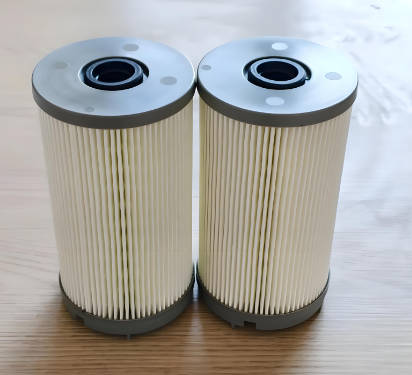
Types of Aviation Fuel Filters and Samples We Analyze
- Main engine fuel filters (micronic paper elements, typically 5–10 µm absolute retention)
- Fuel filter/water separator coalescers (for removing free water from jet fuel)
- Filter monitors (differential pressure indicating filters)
- Refueling vehicle filters (high‑flow, high‑capacity for hydrant dispensers and tanker trucks)
- Micronic filters from APU (auxiliary power unit) fuel systems
- Fuel tank vent filters (prevent particulate ingress into tanks)
- Samples of filter elements removed during scheduled maintenance (at flying hours intervals)
- Failed or prematurely clogged filters submitted for failure analysis
- Fuel samples taken upstream/downstream of the filter (for comparative analysis)
- New reference filters (for baseline cleanliness comparison)
Key Contaminants and Defects Detected in Aviation Fuel Filters
- Metal particles – Iron, steel, aluminum, copper, brass, nickel alloys, titanium. Sources: pump wear, gearbox wear, fuel nozzle erosion, tank corrosion, or metal debris from manufacturing/repair.
- Elastomer and seal fragments – O‑ring pieces, gasket particles, hoses. Indicate seal degradation, incompatible fuel additives, or improper installation.
- Fibers (organic and synthetic) – Cotton, polyester, aramid. Originate from cleaning rags, clothing, filtration media breakdown, or fuel hose linings.
- Sand, dust, silica – Atmospheric contamination entering through tank vents, refueling nozzles, or during maintenance.
- Rust and corrosion products – Iron oxide/hydroxide. Indicate moisture in the fuel system, tank corrosion, or pipework degradation.
- Microbiological growth (diesel bug, fungus, bacteria) – Colonies of Hormoconis resinae, Pseudomonas, Cladosporium, etc. Identified by culture or by visual/laboratory examination (slime, black/brown deposits, smell).
- Water (free and emulsified) – Detected by Karl Fischer titration or visual signs (opaque layer). High water load accelerates corrosion and microbial growth.
- Fuel degradation products (gums, varnish, peroxides) – Indicate aged fuel or thermal stress.
- Filter media damage (tears, ruptures, pleat collapse, migration) – Causes unfiltered fuel bypass, found during dissection.
- Excessive pressure drop (ΔP) before removal – Indicates filter loading; we correlate contaminant mass with ΔP data.
Analytical Methods and Test Procedures
1. External Visual Inspection and Dimensional Check
Before cutting open the filter, we document the external condition (dents, corrosion, seal condition, markings). We measure the differential pressure indicator setting (if present) and record service hours. Photographs are taken for evidence.
2. Filter Element Dissection and Media Examination
Under a fume hood (to avoid inhaling fuel vapors), we carefully cut open the filter canister using a tube cutter or band saw. The filter element is removed, and both the inside and outside of the pleats are inspected visually with a magnifying lamp (10× to 30×) for pleat collapse, media tears, end cap seal integrity, bypass valve condition, and collected debris distribution.
3. Gravimetric Determination of Contaminant Mass (Total Solid Contaminants)
The entire filter element is dried at 60°C for 1 hour (to remove fuel), then weighed before and after thorough cleaning. The contaminant mass (grams) is calculated. This value is compared to the filter’s theoretical dirt‑holding capacity (specified by manufacturer) and to similar filters from the same fleet. An unusual increase suggests upstream contamination or extended over‑service.
4. Particle Size and Morphology Analysis (Optical Microscopy and SEM‑EDS)
Extracted debris is washed from the filter media using petroleum ether or n‑heptane, filtered onto a membrane, and examined under an optical microscope (100× to 400×). Particles are classified by size range (e.g., 5–15 µm, 15–50 µm, 50–100 µm, >100 µm) and by type (metallic, non‑metallic, fiber, etc.). For elemental identification, scanning electron microscopy with energy‑dispersive X‑ray spectroscopy (SEM‑EDS) provides composition of metallic particles (e.g., Fe, Al, Cu, Ni, Cr, Ti) – crucial for tracing back to specific components (bearing race, gear tooth, pump rotor).
5. Water Content in Filter Media and Fuel Samples
Water retained in the filter media is extracted with anhydrous isopropanol and measured by Karl Fischer coulometric titration. Free water in the fuel sample (if provided) is measured by visual inspection (clear and bright test) and by Karl Fischer. For aviation fuel, maximum allowable free water is typically 15 ppm; high water loads indicate inadequate water separation or tank condensation.
6. Microbiological Analysis (Fungal and Bacterial Cultures)
Swabs from the filter media and from the fuel sample are plated onto selective agar media (e.g., Sabouraud dextrose agar for fungi, nutrient agar for bacteria). Incubation at 28°C (for fungi) and 37°C (for bacteria) for 5–10 days. Colony forming units (CFU/mL or CFU/filter) are counted. Identification of Hormoconis resinae (the most common jet fuel fungus) is confirmed by morphology. Heavy growth requires biocide treatment and fuel system cleaning.
7. Filter Differential Pressure (ΔP) Correlation and Hydraulic Performance
If the used filter is still intact, we measure its pressure drop at rated flow (using a test rig with calibrated flow meter and pressure transducers) and compare with a new filter. The ΔP increase (clogging factor) is expressed as a percentage of the new filter ΔP. A ΔP exceeding manufacturer recommendations (e.g., > 20 psid) indicates immediate replacement is needed.
8. Ferrography or Particle Quantifier (for metallic wear debris)
For high‑precision engine components, we use a direct‑reading ferrograph or particle quantifier to measure the concentration of ferrous wear particles in the debris. This helps differentiate normal wear from abnormal wear events (e.g., bearing distress).
9. Fourier Transform Infrared Spectroscopy (FTIR) of Fuel and Extracted Deposits
Infrared analysis of solvent‑extracted deposits identifies organic compounds such as gums, lubricating oil residues, elastomer degradation products, and fuel oxidation by‑products (carbonyl peaks).
Interpretation and Acceptance Criteria (Typical Benchmarks)
The following are industry‑accepted guide values. Airlines and MROs must provide their specific rejection limits based on aircraft type and engine manufacturer requirements.
- Metal particle concentration: no particles > 100 µm allowed; limited number of 50–100 µm particles.
- Water content in fuel: < 15 ppm (free water) at point of use.
- Microbiological growth: no visible slime; colony count < 10 CFU/mL (action if > 100 CFU/mL).
- Filter pressure drop: < 70% of bypass valve opening pressure (or < manufacturer’s recommended change ΔP).
- Filter element integrity: no media tears, pleat collapse, or end cap separation.
- Ferrous debris (PQ index): < 0.5 for normal wear; > 2 indicates severe wear (needs engine inspection).
Reporting and Deliverables
Each aviation fuel filter analysis report includes:
- Filter identification (aircraft type, engine type, filter manufacturer and part number, serial number, hours in service, removal reason)
- External and internal visual inspection photographs (before dissection, after dissection, with annotations)
- Gravimetric contaminant mass (grams) and comparison to expected range
- Particle size distribution table and representative optical/SEM images
- Elemental composition of metallic particles (EDS spectra and quantified elements)
- Water content (ppm) in filter media and in fuel sample
- Microbiological culture results (CFU counts, species identified)
- Differential pressure measurement (kPa or psid) and clogging factor (ΔP ratio)
- Conclusion: “Satisfactory – normal wear”, “Action – abnormal contamination (e.g., high metal, water, microbes) – recommend investigation”
- Specific recommendations (e.g., inspect fuel pump, test fuel storage tanks, add biocide, reduce filter change interval)
- Raw data (spectra, chromatograms, culture plates) archived for 10 years
No statement of compliance with any external standard is made unless the client has provided specific acceptance criteria in writing. The report is intended for aviation safety management, maintenance planning, and regulatory compliance.
Applications in the Austrian Aviation Industry
- Commercial airlines (Austrian Airlines, low‑cost carriers based in Vienna): Routine analysis of main engine fuel filters to detect early wear of fuel pump bearings, nozzles, and seals.
- Business jet fleets (Salzburg, Linz, Graz airports): Filter analysis for jets operating from smaller fields with variable fuel quality.
- Helicopter operators (mountain rescue, air ambulance): Impact of fuel uplift from remote fuel depots – microbial and water contamination risks.
- MRO providers (Vienna maintenance hubs): Failure analysis of filters removed due to low fuel flow or high differential pressure alerts.
- General aviation (clubs, flight schools): Small‑scale filter analysis for piston engine aircraft fuel systems.
Why Choose ZKGX?
- State-of-the-art analytical equipment
- Highly qualified scientific team
- Fast turnaround time
- Competitive pricing